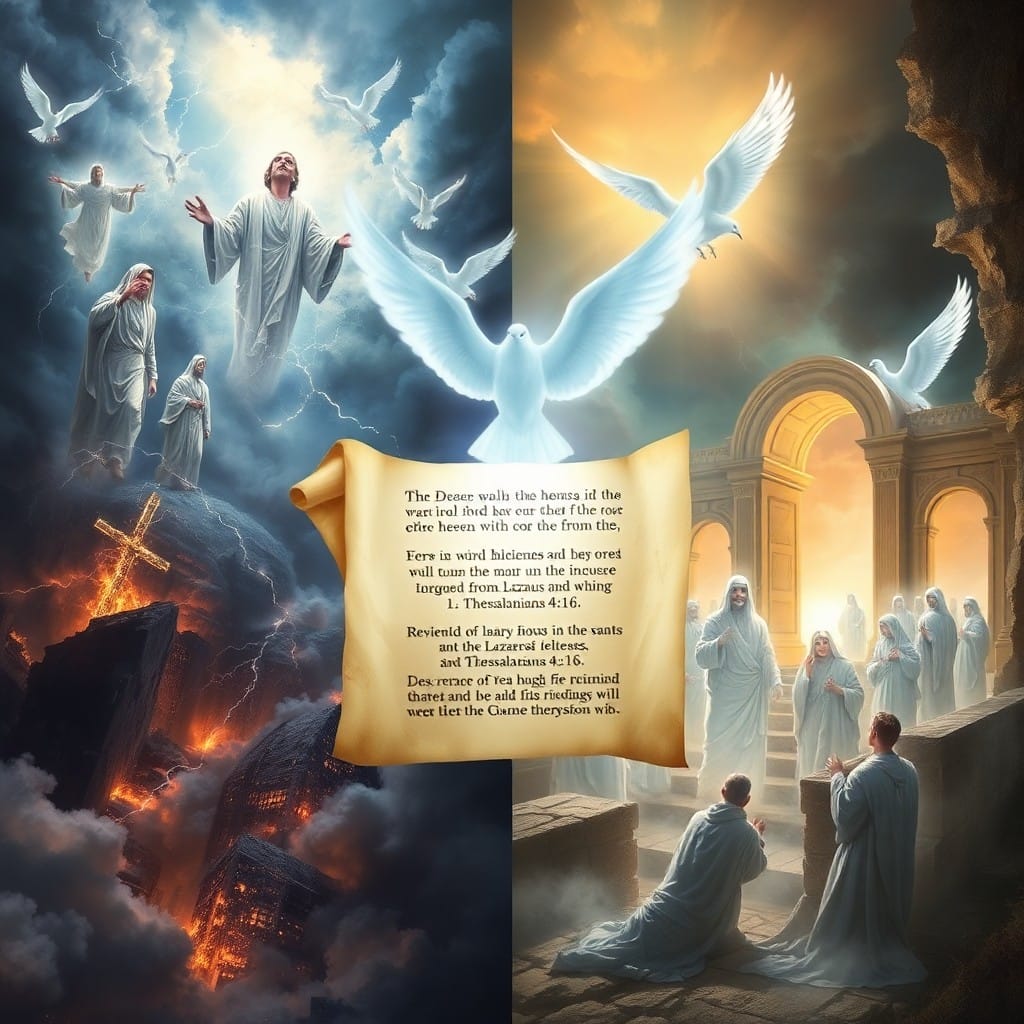
What if the most pivotal moment in Christian eschatology was hiding in plain sight—named after a man who died twice?
The concept of a "first resurrection" in Revelation 20:5 has sparked debates for centuries. But when viewed through the lens of pretribulation rapture theology, it becomes a cosmic game-changer. This article uncovers how early Christians—and modern believers—saw a coded blueprint for escape in Lazarus’ story, the Thessalonian letters, and John’s apocalyptic visions.
1. The Dead Rise First: A Plot Twist Even Lazarus Didn’t See Coming
Pretribulation theology hinges on a sequence: believers vanish before global chaos. The key clue? 1 Thessalonians 4:16-17 spells it out:
- “The dead in Christ shall rise first… then we which are alive… shall be caught up together.”
- This “first” resurrection contrasts with Revelation 20:5’s martyrs, who rise after the millennium.
Why does order matter? Ancient Jewish burial practices reveal a metaphor:
- Just as Lazarus was resurrected before Christ (John 11), pretrib theology argues saints are glorified before tribulation judgments.
- Early church writings compared this to Exodus 34:20’s “firstborn redemption”—a template for prioritized deliverance.
2. The Tribulation Timing Hack: Why Cosmic Clocks Point to an Escape Hatch
Revelation’s timeline hides a loophole for believers. Matthew 24:29-31 and Luke 21:28 reveal a pattern:
- Cosmic disasters (darkened sun, moon turning red) occur after tribulation.
- Pretrib logic: If saints are gathered at Christ’s visible return (post-trib), why does Paul describe a silent, sudden catching away?
The answer lies in two distinct resurrections:
- The “Lazarus Group” (1 Thess 4): Instant, invisible, pre-judgment.
- The Martyrs’ Reward (Rev 20:4-5): Post-millennial, tied to earthly rule.
A 3rd-century theologian once wrote, “The firstfruits ascend like Elijah’s chariot—unscorched by the fire below.”
3. No Tears in the VIP Lounge: How the New Jerusalem Skips the Apocalypse
Revelation 21:4’s promise—“no more death, sorrow, or crying”—clashes with tribulation horrors. Pretrib theologians ask: How can glorified saints experience peace if they’re enduring plagues?
The solution? A pre-trib evacuation to a “holding zone”:
- 1 Corinthians 15:51-52 describes a transformation “in the twinkling of an eye.”
- Revelation 7:9-14 shows a crowd in heaven before the worst disasters, “coming out of great tribulation” (implying they were removed during it).
Early Christians saw this as a divine loophole, like Noah’s ark floating above the flood. Modern believers joke: “Why sit through the previews if you’ve got backstage passes?”
What’s Left Unsaid: The Mysteries Even John’s Vision Didn’t Reveal
The “first resurrection” debate rages on, but the intrigue deepens:
- Why does Revelation 22:17 suddenly plead, “Come!”—as if readers could hasten their exit?
- Could 2 Thessalonians 2:3’s “falling away” hint at a spiritual defection that triggers the rapture?
One medieval monk scribbled in a margin: “The elect vanish like dew—seen only by the dawn.”
Want to dig deeper? Explore how Exodus’ firstborn redemption rituals secretly map to end-time escape plans… or why Lazarus’ second death (as a mortal) might hold clues about resurrection tiers. The archives—and the apocalypse—are full of surprises.